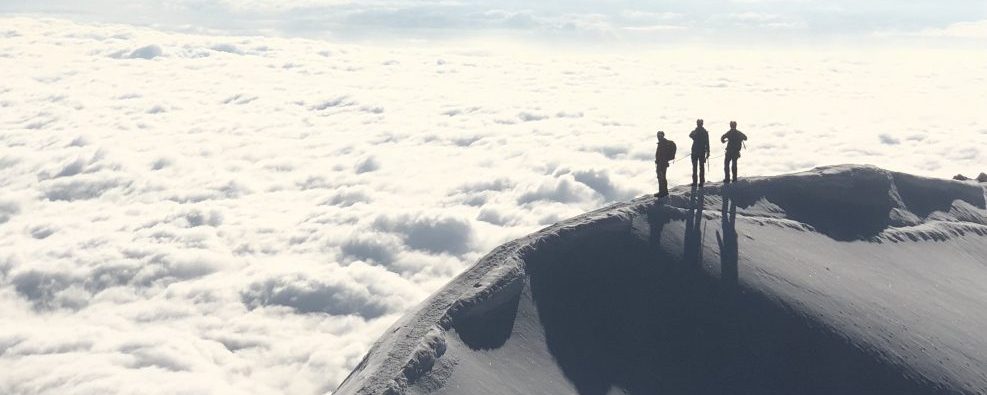
Next summit: Motherhood
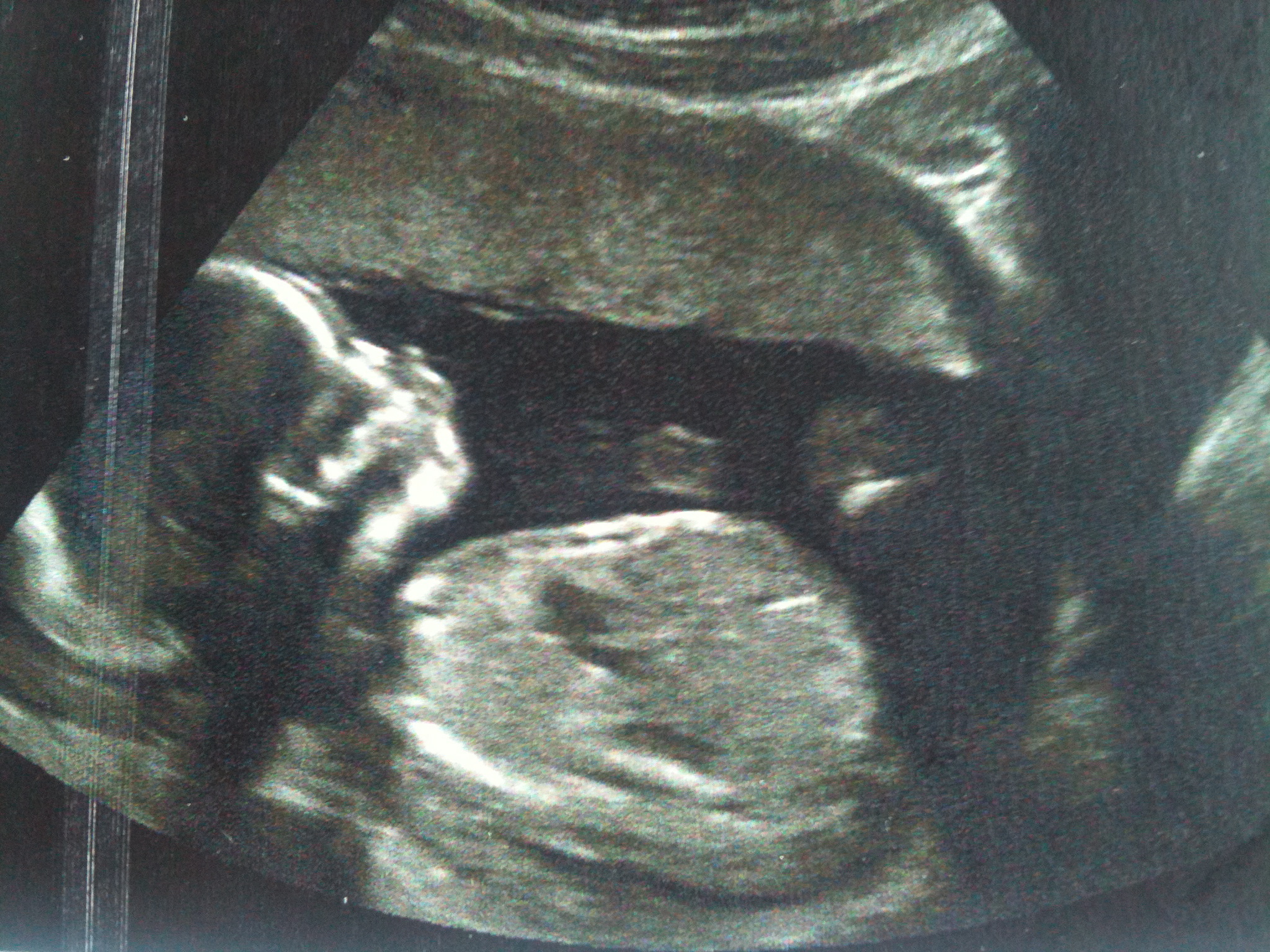
Life goes in stages. For me at least, it does. You go through college, graduate and wonder: “What’s next?” You find your dream job, settle into it and one morning you look at yourself in the mirror and wonder: “What’s next?” I have a passion: climbing. And I am always wondering what the next climb is going to be. But to give it more meaning, I decided to become a guide and communicate my passion to others. So, I went through the guide’s training to become fully IFMGA certified. I built my own company, Into The Mountains, and clientele and have been loving every moment of it, along with my career as an athlete for First Ascent and other companies (Petzl, Julbo, Scarpa). But one morning, after a very busy season, I woke up, looked at myself in the mirror and wondered: “What’s next?”
Well, truth be told, it didn’t happen quite that “overnight.” I have always thought that the day I have kids, my climbing life would end. Climbing, guiding, being a professional athlete, etc. would disappear from my life, and I therefore needed to do every climb I possibly could before then. I wouldn’t say that the pressure came as much from my environment as it did from me. I knew I should have kids, but I didn’t know when the right time would be, after which climb I should decide to give it all up for kids. People have often said that they haven’t done some of the climbs they wanted to do because they wanted to be a responsible parent, which is most likely why I always felt that my life as a professional would end with children. Maybe it’s in response to that that I decided to become a guide so that the day I would have kids I could justifiably still go out and play, all the while working and getting some exercise and coming home without the need to go out and do more training.
That said, 2011 has so far been one of the most prolific and exciting years of my life. I got to climb in Antarctica, Thailand, Jordan, ski-guide all over the Alps (Silvretta, Bernina, Haute Route, etc.), climb the Supercouloir with one of my best friends, Tania, do a one-day ascent of the north face of the Eiger with my husband, Adam, move into a great apartment that Adam remodeled while I was away in Antarctica and many other great moments shared with friends and family.
Filled with all of these great experiences, I hit a bit of a wall in May. I was climbing with Adam on the Grand Capucin, one of the most world-class and spectacular peaks in the world, no less, when I realized that as much I loved climbing and guiding, I suddenly felt the urge for something more to balance out my life. Too much of a good thing can kill a good thing, is the saying, right?
As I climbed up the soaked blank granite face, I realized that I just didn’t want to be there. A tough realization for a climber. I reached Adam and with tears in my voice and in my eyes, I told him that I just wanted to be home and make babies. With a look of terror in his eyes, he said, “You freak me out!” Yet, as hormones would have it, I got pregnant that night (I like to think so; it makes for a better story)—or around that time. I quickly found out that I was pregnant and was elated. It’s not that I had wanted it that badly, but it felt like it was the right time for it. When I turned 25, I decided I should graduate from law school. When I turned 35 (this year), I knew that I should start thinking more seriously about kids. And I did. I think that I had known for a long time, that this year would be the year because last year, when I was trying to ascend Moonlight Buttress in Zion, I was so sad that winter arrived so early, preventing me from getting back on it, because I already knew deep down that I would be pregnant the following year.
That feeling of elation faded with the realization that, well, I was pregnant. Not just in concept, but for real. Something was growing inside of me, something that would change my life as I know it forever. Those words had ruled my concept of parenthood, and I always felt that as a consequence my life as a climber should end with pregnancy. So I went from being elated to being downright sad, grieving the life I had worked so hard to build for myself, grieving my identity, wanting this baby but resenting it, feeling guilty for having these emotions that I was sure the baby would feel. I was confused, torn between what I thought I should feel and what I felt.
Alongside these personal feelings, I was also confused about my guiding. I didn’t know how good or bad it was for the baby that I was going up and down mountains on a daily basis, guiding, taking risks, and more so, putting the baby at risk. That baby has been up more mountains than most could dream of in a lifetime! (My mom recently told me that the baby was going to be born with a backpack on his shoulders.)
July was a really difficult month for me. I was two months into my pregnancy and felt extremely stressed out about the idea of hurting the baby, with the constantly unstable weather patterns and having to modify all my guiding days and many other aspects of my life.
I think it took getting injured for me sit back and understand that this wasn’t the end of my life as I knew it. I was climbing on the Weissmies on flat terrain when I missed a high step and landed shin-first on a knife-edge boulder, cutting my shin open to the bone. I continued guiding to the summit and down, and went to the doctor’s when I returned to the village below. While waiting to get stitched up, I was hit by a wave of heavy tears. I was like a two-year-old, inconsolable, weeping like I never had before. I took a few days off, rested and accepted the fact that I am pregnant and am lucky to be able to work while pregnant. Many other women have gone through this before and many will after me and it’s just a part of life, a part of making choices and working around them to make it work as best you can.
I think that you can make parenthood whatever you want it to be and still be a responsible parent. Having kids doesn’t necessarily mean settling down. Maybe it will bring more structure to my life, forcing me to be more focused to keep achieving my dreams, but I hope that I won’t use my kids as an excuse to no longer pursue my dreams.
That said, I know that my lifestyle is particular and fitting a kid in an already very busy schedule won’t be easy but I think my life will be all the more rich for it. After all, I picked guiding not just to share my passion with others, but also because I believe that it’s very compatible with parenthood. I get to exercise all day long and be available to my kid when I get home at night, not needing to go out and exercise some more. And during the off-season, I will possibly be more available than a 9-to-5 parent could be.
I am now 3.5-months pregnant and have been guiding through the summer and loving every moment of it, since my little accident. The season is coming to an end and I am looking forward to climbing for myself again and finding the space to do other things that are more suited to pregnancy. Pregnancy is a lot like doing a first ascent. Although many people have done first ascents and have been gone through motherhood before, your own seems like the first of the first; you can only hope that all of the skills you have accumulated in your life until now will enable you to overcome the challenges ahead and lead you to a successful summit, this one this time being motherhood.
Reflecting on rapidly changing glaciers in the Alps
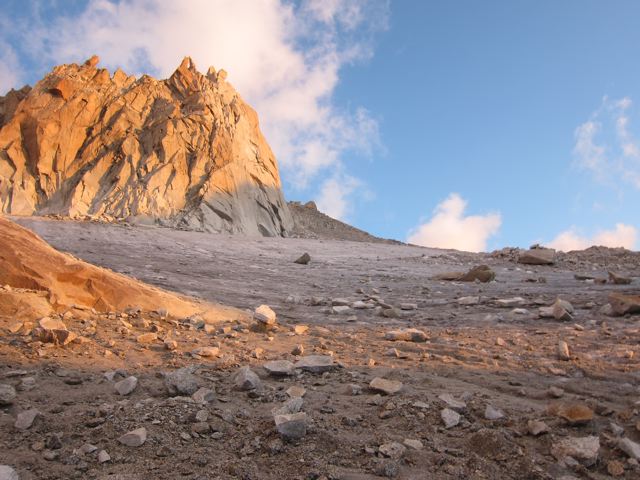
Summer in the Alps went from being inexistent to full blast. It’s the hottest month of August in years. I am grateful for this spell of beautiful weather myself, but after this past few days in the mountains, I realize that glaciers aren’t as happy as me. They are downright hurting.
I just had an amazing week with my client, Michele. Michele is a well-rounded climber who goes out climbing on her own (as in, without a guide), both on rock and ice and has climbed all over the world. She’s been to destinations I still dream about going to myself. After a week of hiking to acclimate around Chamonix, she was ready for our trip into the mountains. Since I hadn’t climbed with her before, we headed to the Albert 1er hut the first day to climb a moderate ridge to the summit of the Aiguille du Tour, a peak which sits on the border to France and Switzerland. Upon reaching the hut, though, I wondered where the glacier had gone. The last time I’d been there was in 2002, and the glacier was minutes from the hut. I blamed it on my bad recollection of the area but a fellow guide confirmed that the glacier had just shrunk drastically.
After a beautiful climb up the Arête de la Table (called as such because a flat rock somehow sits on the ridge and you have to climb around and then on top of it) to the summit of the Aiguille du Tour, we returned to Chamonix. We spent the following days climbing perfect granite on the Aiguille du Peigne’s Papillons Ridge and ice on the Goulotte Chéré followed by the classic Cosmiques Ridge. We then headed over to Switzerland to spend three days climbing around the Trient Hut, located on the Swiss side of the Mont Blanc Range. Although I had hiked up to that hut earlier this summer, it was still early and the snow hadn’t fully melted off so I wasn’t as shocked as now.
I first came to this area in 1996 with my parents to climb a route right above the glacier. We had stayed at the Orny Hut, just an hour down valley form the Trient Hut. From there, we hiked a few minutes to reach the nearby glacier and hiked on it to reach the climb. Nowadays, you couldn’t even imagine doing that. The glacier is 150m below the hut and nowhere on the way to that climb anymore. Five years ago, the glacier in that area was still fully an accumulation zone, but now, it’s turned to an ablation zone, leaving very little time for this glacier to survive.
After a nice night of sleep at the newly guarded Trient hut with Michele, and the most amazing vegetable curry cinnamon (yes, cinnamon) soup I have ever eaten, we headed out the door at 5 a.m. for our climb, the south ridge of the Aiguille Sans Nom (Nameless Tower), a beautiful line up perfect orange granite. This area is a little remote and both times I was back there this summer, I didn’t see anyone! A treat! We hiked up the Trient glacier to the Col des Plines and headed down into a wind scoop to come out at the pass. I expected the backside to be fully covered in snow, as it had been when I was there five years earlier. But instead we found scree and very loose terrain, leading to a totally dry glacier. I couldn’t believe it. Poor Michele, she had to listen to me repeat over and over how different it was this time around, just like an old woman saying: “Back in the days…”
It didn’t stop us from having an amazing climb up perfect granite to the summit of the Aiguille Sans Nom, followed by some ridge climbing down the easterly ridge of the Aiguilles Dorées (Golden Needles) and some rappels back to the Trient glacier. We had an amazing week with great weather and I was in great company with Michele. Yet, I can’t brush off the images of the once-huge glacier that I knew and wonder how much longer it will be around for us to see and marvel at. We used to look at pictures from the 1920s to see how much glaciers had shrunk. But now you just need five years time to no longer recognize a location you thought you knew. I don’t have a solution, of course, but this was a reality check I thought I should share.
[nggallery id=18]
Why Climbers – not the climb or the guide – make a great climb
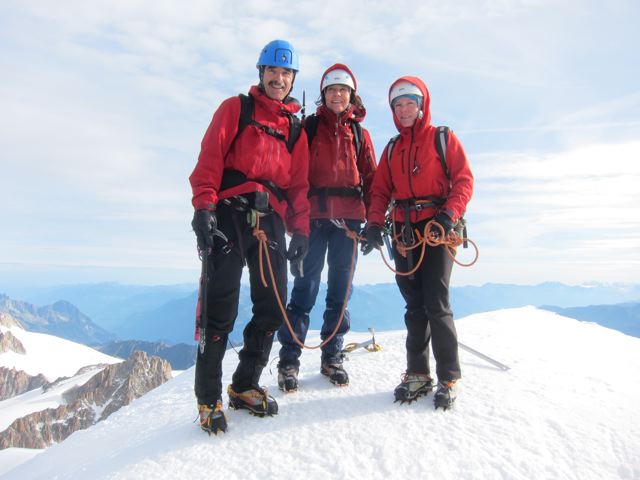
More often than not, what makes my day as a guide or as a climber is not as much the climb as it is the people I guide or climb with. Guiding the Aiguille d’Argentière—a 3,902-meter high peak above the Argentière Glacier in Chamonix—was no exception to the rule. After canceling three days of guiding due to bad weather, I took on some random work with local guide services to make up for lost work. You never know who you are going to have as clients when you work for other companies, so I didn’t know if I should be excited or not about this climb, but I had low expectations because I didn’t have a personal relationship with them and felt that I couldn’t disappoint. If anything, I would get to summit a peak I had not yet stood on. I had tried to ski it the day I returned from Jordan this past March, but the snowpack hadn’t settled enough and we turned around at the base of the steep slope.
The clients were a Swiss couple in their 50s with some climbing experience. I met them at the base of the cable car and after making sure they had all the necessary gear, we rode up to the top of the Grands Montets cable car. In winter, you would ski down the Glacier du Rognon to the Argentière Glacier before starting up the climb. Hiking down in the summer isn’t nearly as much fun, but the beauty of scenery makes up for it. A few hours later, we were at the Argentière hut. From there, the view stretches to the south to the spectacular north faces of the Verte, Droites, Courtes and Triolet. With all the recent precipitations, the routes up the north faces looked nearly in condition (in the summer, they are usually shedding rocks nonstop). The hut has just been remodeled and it is lovely to stay in such nice places in the mountains. They cooked what could be the best meal I’ve had in a hut: a homemade soup followed by a Moroccan tajine. Yum!
We woke up at 4 a.m. to start on our climb. We followed a faint trail in the dark and made our way through a treacherous boulder field before reaching the disappearing glacier. This glacier is named the “Glacier du Milieu” (Middle Glacier) because it rises steeply between two magnificent and flamboyant jagged rock ridges, both topping out on the summit. The climbing is pretty straightforward, despite a few sections where we had to navigate through a maze of crevasses. After the bergschrund, the slope drastically steepens. We made good use of the cramponing technique we had perfected on the dry glacier the previous day on our way to the hut, and made it safely to the summit. A biting northerly wind greeted us on top: I quickly added my Igniter Jacket to enjoy the beautiful panorama, stretching to the south to Mont Blanc and the Grandes Jorasses and to the north to the Swiss Alps. We soon started back down. Descending steep slopes is where you are the most at risk, so we took our time, making sure each of our steps was secure.
Once the difficulties were over we were able to talk a lot more. The clients—both doctors—told me about where they live, their passion for the mountains, for nature and for the environment (having even built a fully environmentally efficient house), about their kids (their daughter is a Swiss champion rock climber for under-16-year-olds) and much more. After what has been a bit of a difficult summer with the weather, meeting such great clients (and having nice weather) really brought home why I was guiding and why I love to guide. I sometimes feel that clients can bring more to the guide than the guide can bring to them by taking them to a summit. Clients always bring a lot to the plate, but this time, maybe because I had low expectations, there was room for me to let myself be surprised. And this was definitely one of these special times when clients made my day.
[nggallery id=17]
Dealing with feisty weather in the Alps

One thing I love about my job is this: It sure keeps you on your toes…both figuratively and literally, of course. But this year has been more on the figurative side of things.
Europe has been hit by a southwesterly flow of weather that even the best forecasters have had a hard time understanding and interpreting. Since guiding is very weather dependent, it has made my job quite difficult…but all the more interesting.
Clients email me way ahead of time to book me for their dream climbs or their dream week in the Alps. And it really means the world to me to do my best at making them discover my backyard, in the hope that they will love it as much I do, that they will enjoy the climbing and get to reach their dream summit. For this to happen, though, three factors must be met: The client must be in good enough shape to achieve their goal; the conditions on the route must be good; and the weather must be decent. Last summer, this was hardly ever an issue. Sure, there were times when I had to rack my brains a little in order to find a better destination than the one originally planned, but it was the exception to the rule and there was always a great alternative to be found. This year, however, I can’t recall many days going according to plan.

Guiding can be intense in itself, because you have to plan for the climb, figure out what the itinerary is going to be, book huts and hotels and cable cars (a perk, really!), make sure conditions are good on the route, brief clients on what to expect on the climb, what gear to take, make sure they have the gear they need and that they are using it right, make sure you have the right gear to guide a climb, pack your bag, manage clients on the climb, acknowledge hazards and manage them, come home at night and repeat for the following day. But this year’s unstable weather has added a whole new level of stress.
At the end of July, I had a great client to climb both the Mittellegi Ridge on the Eiger and the Hörnli ridge on the Matterhorn. I met him the day before the trip started with the weather outlook in hand and had to break the news to him that none of these climbs would happen. That’s always really hard for me to do because people have traveled from far away for this, took time off work and away from their family, all to do “Plan B” climbs. But weather and conditions are something that I can’t manage and that’s a responsibility I always have a hard time not taking on as my own. So I try to find other satisfying options, but this summer, the weather forecast would drastically change from the one posted in the morning to the one posted in the evening, forcing me to constantly change plans and adapt. This was stressful but we almost always made it work.
This past weekend, however, the forecast was for three days of beautiful weather initially—and ended up being the worst three days of the summer throughout the Alps. Even further south, where the weather was nicer, the winds reached up to 50 mph at lower elevations. So we resorted to going to the museum and eating ice cream. Sometimes you just have to accept the reality and not try to force things. And I think clients are understanding of that, but I always wish I could have done more and found where the one patch of dry weather was hiding and made it work.
As I write this, the sun is blasting through my window and I am about to head on up to a hut for the first bluebird day of guiding in a long time! This spell of bad weather makes me appreciate the sun and beauty of the mountains all the more. It will be such a nice change to be able to focus on my job and on the clients, and not worry about the weather.
Weissmiess Traverse

The Weissmies is one of the easternmost 4,000-meter peaks in the Alps and is close to the Swiss/Italian border, in the Saastal, opposite from the famous ski resort, Saas-Fee. Because it doesn’t sit right on the main crest of the Alps, it is more sheltered than the peaks in the neighboring valley of Zermatt and often gets better weather. With this year’s spell of bad weather, it’s been my peak of choice for uncertain weather days.
It’s a bit of a drive to get there from Chamonix. You drive over two passes and then up the Rhone valley, going from the French to German speaking part of Switzerland, and eventually up the narrow and windy road to the Saastal, a V-shaped valley dead-ending at the Mattmark dam.
The hike to the hut the first day was really awesome. In Europe, there are lots of lifts to access areas, even in places where you couldn’t imagine a real use for them. Sometimes the lift is just to access a house, a pasture for cows or sheep, a small village or just for leisure. But I am always grateful for them as they save my body from overuse. We parked the car in SaasAlmagell (all the towns in this valley start with the word “Saas”) and took a small lift up to a tiny hamlet in the mountains. From there, the paths winds through a steep cliff, over manmade bridges, metal steps bolted onto the rock and onward to the Almageller Valley. It is such a contrast from the States, where no manmade structure is allowed in parks or in the mountains. Here, everything is made to be playful, yet it doesn’t seem to really interfere with nature. It’s discreet and not shocking at all.
It takes about three to four hours to hike to the Almageller Hut, with a little break halfway at Almageller Alp—a little restaurant in the middle of nowhere—for a nice, refreshing drink before starting up the steep section the hut. You can only see the hut once you’re 10 minutes away from it. This hut has to be the most beautiful I have ever been to, with a huge terrasse, beautiful stairs, a stream that runs along it, a kitchen that is so polished you can see your reflection in the metal cabinets, beds with nice comforters, all you can eat homemade delicious meals, etc. It’s a real haven and it’s no wonder it’s so popular.
In the morning, we follow red-and-white painted signs on the rocks all the way to a pass before starting up the ridge leading to the summit of the Weissmies. The peak offers a great diversity of rock scrambling and beautiful, thin, snow ridges. I had never done this traverse until this year and almost didn’t get to finish the first time. Pretty high up on the climb, I missed a step and hit my shin hard on the rock. I didn’t want to cry so I just rubbed really hard on my shin to make the pain of what I thought was a bruise go away. When my client asked if I was bleeding, I lifted my pants and realized that not only was it an open wound, I could also see the bone. I breathed hard and with the help of other climbers on the climb, dressed the wound nicely and kept going to the summit, which was only another hour away. I knew that I would be getting stitches within the next few hours. So long as I was moving, I was fine, but when I stopped, the pain came crashing down on me. I was relieved to finally get anesthetics for the stitches and forget about the pain. I wasn’t able to guide for the rest of the week.
A week later though, I was back on that same peak with another client and had a flawless ascent. The descent goes down the north face back to the Hohsaas lift, which in turn takes you back down to the valley floor, giving your knees a few more years to live!
Because of its location, the fun and beautiful approach, the lovely and welcoming hut, the beauty of the ascent and of the peak itself and the lifts taking you down once you’ve descended the north face, the Weissmies is one of my favorite moderate 4,000-meter destinations.
[nggallery id=16]
Caroline on Why she guides
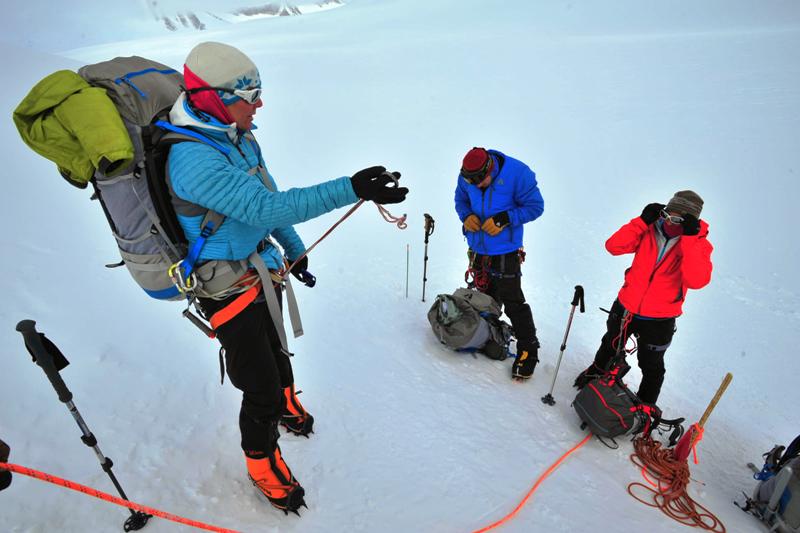
In 1997, I had a nasty accident in the mountains. I fell 1,200 feet down a mountain and spent two months flat on my back in a hospital, staring at the ceiling and thinking that if only I’d had more knowledge of the mountains and how to recognize and manage hazards, I possibly wouldn’t be all broken. Although I’d enjoyed the mountains until then, a furious passion for them ensued from my fall. I knew then that I would become a guide.
Yet, becoming a guide – and a woman guide at that – isn’t an easy road. You have to want it, to live it, to have it so deeply ingrained in your blood that it becomes the essence of your life. Maybe for some it doesn’t have to be quite so extreme, but it did for me.
I didn’t know many people who could take me and teach me. So I decided to follow the motto: “If you don’t know it, teach it” and took my friend Floriane with me all over the mountains. I had no idea how to do things, and I often covered my lack of skills by blaming her for doing things wrong. She was a good sport, and with her I learned a lot through my mistakes and our successes. I climbed mountains like there was no tomorrow, going 10 to 20 days without a break, in all sorts of weather and conditions. I recorded my every climb in a diary, writing in the time it took me, with whom I had done the climb, how hard the climb was, and with ski touring, I kept track of every vertical foot I climbed each winter. It was a religion. I would drive cross-country to do a climb, not counting the time it took or money it cost. Nothing else mattered; it was as vital to me as eating and drinking. My parents were worried.
I filled out the guide course application with a shaking hand. It is scary to get close to your dreams. I wanted this so badly that I didn’t listen when I was told that I had to work on my steep skiing skills. From my accident in 1997, I experienced a great fear of falling down a steep slope. I just pushed on.
During that time, I experienced a very tragic loss and a turning point in my life. I didn’t know if I should pursue guiding. I was simultaneously doing my internship to become a lawyer and hated it. But I realized I had to pursue my passion. So instead of quitting the guide courses, I quit law, and this course became my reason to live.
Dealing with weather in the Alps

One thing I love about my job is this: it sure keeps you on your toes… both figuratively and literally, of course. But this year has been more on the figurative side of things.
Europe has been hit by a southwesterly flow of weather that even the best forecaster have had a hard time understanding and interpreting. Since guiding is very weather dependent, it has made my job quite difficult…. but all the more interesting.
Clients email me way ahead of time to book me (link to: www.intothemountains.com<https://www.intothemountains.com>) for their dream climbs or their dream week in the Alps. And it really means the world to me to do my best at making them discover my backyard, in the hope that they will love it as much I do, that they will enjoy the climbing and get to reach their dream summit. For this to happen though, three factors must be met: the client must be in good enough shape to achieve their goal, the conditions on the route must be good and the weather must be decent. Last summer, this was hardly ever an issue. Sure, there were times when I had to wreck my brains a little in order to find a better destination than the one originally planned, but it was the exception to the rule and there was always a great alternative to be found. This year however, I can’t recall many days going according to plan.
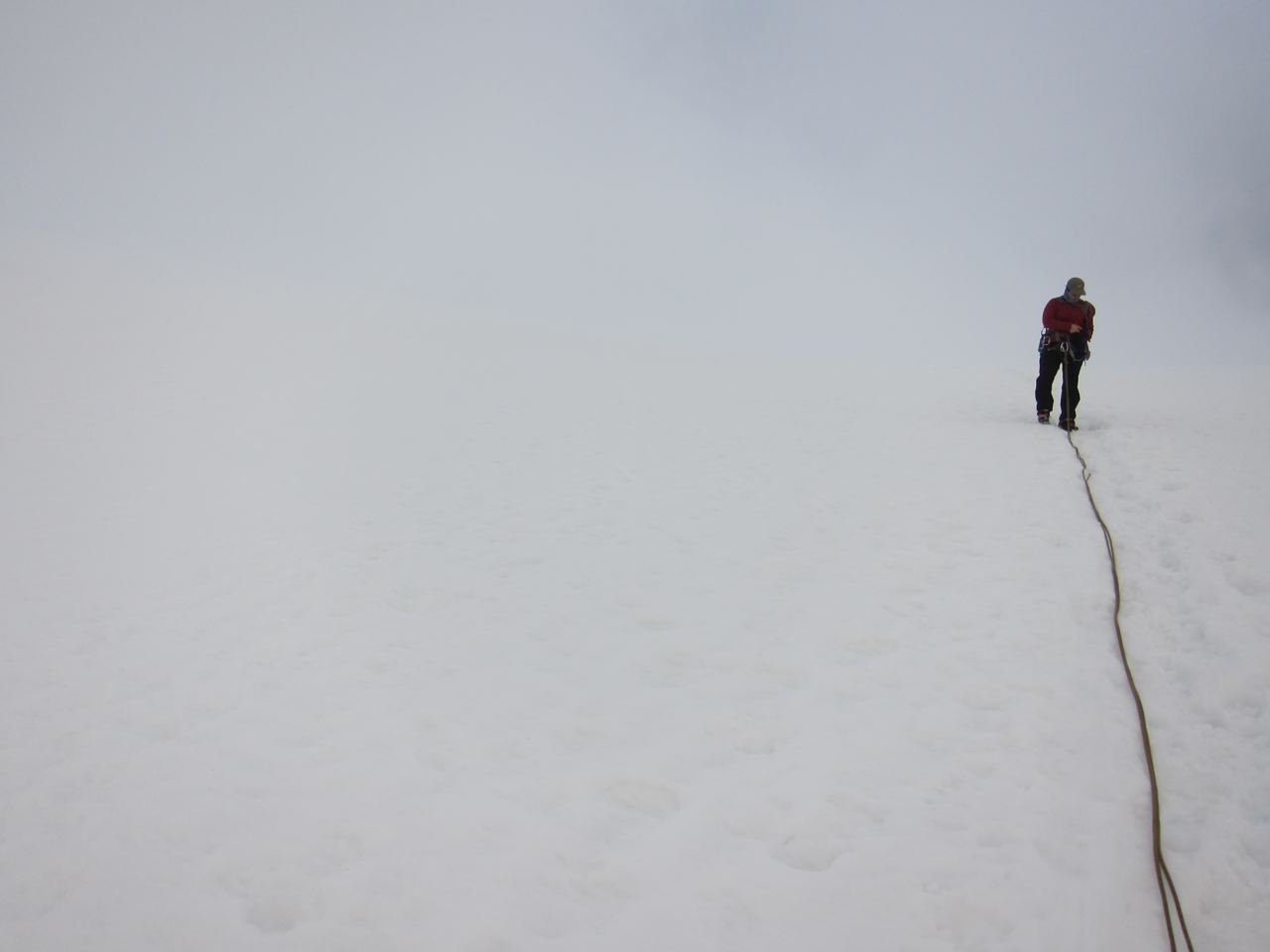
Guiding can be intense in itself, because you have to plan for the climb, figure out what the itinerary is going to be, book huts and hotels and cable cars (a perk really!), make sure conditions are good on the route, brief clients on what to expect on the climb, what gear to take, make sure they have the gear they need and that they are using it right, make sure you have the right gear to guide a climb, pack your bag, manage clients on the climb, acknowledge hazards and manage them, come home at night and repeat for the following day. But this year’s unstable weather has added a whole new level of stress.
At the end of July, I had a great client to climb both the Mitteleggi ridge on the Eiger and the Hornli ridge on theMatterhorn. I met him the day before the trip started with the weather outlook in hand and had to break the news to him that none of these climbs would happen. That’s always really hard for me to do because people have travelled from far away for this, took time off work and away from their family, all that do “Plan B” climbs. But weather and conditions are something that I can’t manage and that’s a responsibility I always have a hard time not taking on as my own. So I try to find other satisfying options, but this summer, the weather forecast would drastically change from the one posted in the morning to the one posted in the evening, forcing me to constantly change plans and adapt. This was stressful but we almost always made it work.
This past week-end however, the forecast was for three days of beautiful weather initially, and ended up into the worst three days of the summer, throughout the Alps. Even further south, where the weather was nicer, the winds reached up to 50mph at lower elevations. So, we resorted to going to the museum and eating ice cream. Sometimes, you just have to accept the reality and not try to force things. And I think clients are understanding of that but I always wish I could have done more and found where the one patch of dry weather was hiding and made it work.
As I write this, the sun is blasting through my window and I am about to head on up to a hut for the first bluebird day of guiding in a long time! This spell of bad weather makes me appreciate the sun and beauty of the mountains all the more. It will be such a nice change to be able to focus on my job and and on the clients, and not worry about the weather.
Trient
The Trient bassin is located on the eastern side of the Mont Blanc range, in Switzerland. It can be accessed from France, but is more commonly approached from Champex, a little Swiss village nestled high on the hill by a beautiful summer lake.
My client was Floriane. By now, you must all have seen numerous pictures of her and wonder who she is. I met Floriane in law school and we have been close friends since. We traveled to Nepal together and Flo was my guinea pig for most of my guiding training, before becoming my amazing client. She is willing to follow me up anything and I trust in her to do her best and persevere through rough sections on climbs. But she is not only a client, she is also a very close friend who is there for me for better or for worse. I am very lucky to have her in my life. With the weather being very iffy these days in the Alps, I’ve changed plans for our week-end about ten times. We went from plans for the Badile, to Italy, to 4000m peaks, to staying close by and explore the Trient area, where we could do something big or small depending on what the weather decided to do.
I have climbed a lot in this area. The joke used to be that we would go up there because the Trient Hut keeper was cute. Now, that he is no longer tending to that hut, the weather and beauty of the place were the next best excuse. We hiked from the top of the Champex chairlift, passed the Orny hut (nope, not horny hut!) and made our way to the base of a beautiful 900ft route called La Moquette. It’s a very moderate 900ft long route that we climbed in big boots. We reached the summit in heavy rain, but were shortly thereafter rewarded by a gorgeous rainbow. I had recommended this route to fellow FA team member Erik Leidecker and saw him at the base of the climb, and later that night at the Trient hut, where we were both staying at.
I was very successful that night thanks to my First Ascent Light Berry MicroTherm Down Shirt, which local women wanted to rip off my back and take home with them. It’s hard to keep the crowds away with such beautiful and technical products 😉
We woke up the following day to heavy rain and no visibility. Flo and I had thought of doing the classic, yet long and committing Traverse of des Aiguilles Dorees (Golden Needles) (http://www.camptocamp.org/routes/54468/fr/aiguilles-dorees-traversee-integrale-des-aretes-e-w) but the weather wasn’t anywhere close to being good enough for that. So we opted for a less committing climb, one that we could rap off of if the weather turned on us again. Flo went back to bed for two hours though, while I sat having breakfast and chatting with Erik Leidecker at the dining room table. Huts are always a great place to chat, reconnect, share experiences, etc. with other fellow guides.
We left around 8am and headed to the south side of the Aiguilles Dorees (Golden Needles), which offers some of the best orange granite in the whole range: 1300ft golden steep faces that shine in the sun and offer line after line of perfect crack and slab climbing. To get to our climb, we crossed over to the Fenetre de Saleinaz then the Fenetre Suzanne to reach the base of the “Promontoire de l’Aiguille Sans Nom” (read a sub-peak of the Nameless Tower). We geared up at the base of the climb, transitioning from boots and crampons to rock shoes while still standing on the glacier and headed up our climb. The climb is called Tajabone and is a 300m long climb which ranges from 5.9 to 5,10b. It’s the most beautiful climb of this grade I have ever done. Each pitch surprised me by its beauty. The second pitch looked like a totally blank wall and I wondered how it could be rated only 5.9, but all the holds were incut, making them invisible from below, but perfect hand holds. The only draw back on the climb was how overly bolted it was. One of the pitch climbed up a perfect hand crack that was fully bolted, something you would never seen in the US. At the end of the climb, we rapped down the route and headed down the Saleinaz glacier to stay at the Saleinaz hut. That hut doesn’t give access to much interesting climbing, so we had it to ourself.
When I returned home, I looked up “Tajabone” to find out the meaning of this word I had never heard before. Tajabone is the muslim equivalent to our Halloween. Along with the definition, I found this beautiful song by Senegal singer Ismael Lo: http://www.youtube.com/watch?v=YUWyUE6kqoU. Goes to show, you can find all sorts of beautiful surprises by going into the mountains!
[nggallery id=15]
Aiguille du Moine
When you stand at the top station of the Montenvers train in Chamonix, France, you see two peaks standing out to the east: The Drus and the Aiguille du Moine, a little further south. The aiguille du Moine is a little smaller at 3412m and a little less steep than it’s neighbour but offers just as good a quality of rock in a setting that is very spectacular. The Aiguille du Moine is surrounded by famous peaks like the Grandes Jorasses, the Verte, the Drus, etc., located in the center of cirque called the “Talefre Bassin”. It is quite remote and therefore doesn’t get too busy.
Because it’s not too high in elevation and south facing, the south ridge of the Moine (read Monk) is quickly in condition. After a very wet month of June in the Alps, this seemed like a great option. Also, after celebrating a wedding until 3.30am the previous night (well, that morning), I was happy to “only” have to hike to the hut on the first day. I met Silke and Floriane at the Montenvers train and we rode the train to the top. The hike starts from the train station and climbs up the world famous “Mer de Glace” (read sea of ice), to some crappy moraine, up very steep ladders and then onward to the hut up a beautiful trail bordered by falshy pink rhododendrons. We arrived at the hut after 4 hours of hiking and quickly downed a nice slice of pie to recover from the effort.
I had done this climb twice before and hadn’t been back to this area. It’s funny how you forget approaches – how long they are -, the route itinerary, the gear you need to take, etc. It makes it even more of a pleasure to return to places, because it often feels like it’s the first time. We woke up at 4am and headed up to the base of the climb. I was shocked to how small the pocket glacier has become. That was quite a striking difference from when I was there last. That, I remembered!
We climbed up the steep snowfield to the center of the south face of the Aiguille du Moine, where both the normal route and the classic south ridge start from. We left our crampons and ice axes there and headed up the very wet – almost riverlike – ledge system that climbs up the left hand side of the face to the south ridge proper. We were greeted by the sun, but only briefly as most of the route climbs up the the westerly side of the ridge. The climbing is up perfect granite and steep wide cracks, which are often polished from traffic. Yet today, we were all alone on the route, which added to the experience. The difficulties aren’t too sustained, but there are a few sections of 5.9 that we climbed in big boots. We enjoyed the summit to ourselves with Mont Blanc in the background, no wind and beautiful sunshine and blue skies.
But the climb isn’t over until you are at the hut. The descent route is quite tricky to find. There is lots of route finding and zigzagging through the maze of the south face. It was 2pm when we reached the bottom of the face and our last train was a 5.30pm. There was no way I was going to miss it, so I told the girls that we had to make a run for it. We quickly had a snack and some water and ran back down to the hut, repacked the bags and kept running down the trail, down the ladders, down the moraine, down the glacier, where we saw lots of people. I thought to myself: “what are these people doing? they should be running down to the train too?”, but I didn’t want to stop and ask, so we just kept going, until we reached the bottom of the ladders that take you up to the train. There, Silke and Floriane told me that they wanted to take a break. It was only 4.20pm and we had plenty of time ahead of us. Relieved, we took our time and slowly climbed back up to the ladders to the train, which took us down to Chamonix, saving us another 2hour descent!
[nggallery id=14]
Presles
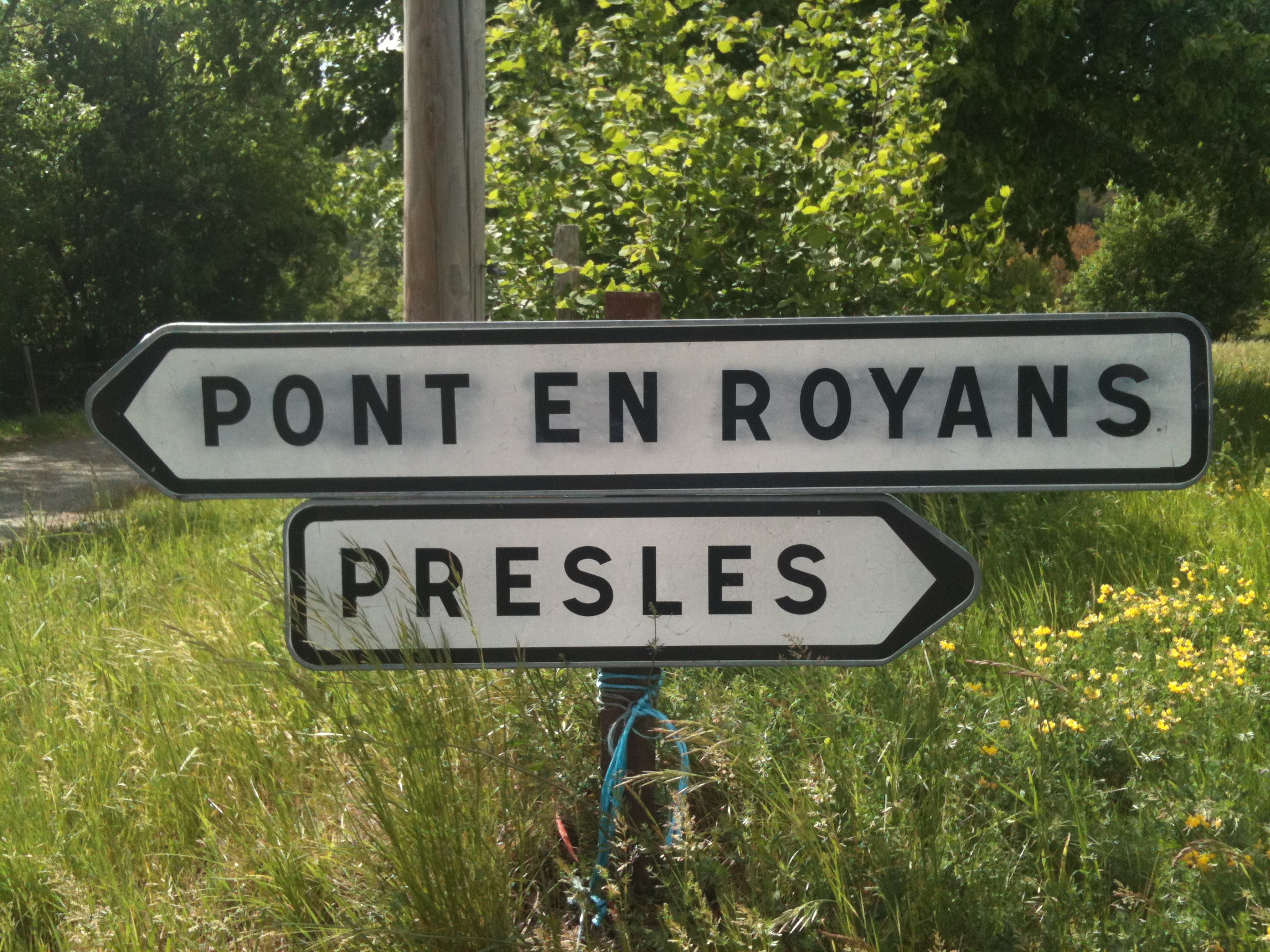
Nestled in the heart of France is the great Vercors range, a beautiful red and grey limestone high plateau whose smooth rhythm is interspersed with steep to overhanging cliffs, sometimes reaching 500m in height.
I had visited this place only once on my way to the Verdon – another world class climber’s destination – further south of France and swore then that I would be back for more, but I also wondered why I hadn’t been there before; Presles is only 3 hours away from my home in Chamonix and I had heard so much about it through my parents who had climbed there a lot back in the ’70s. In fact, they had met there when my mom worked on a farm and owned a cow with a friend. My dad had suffered a climbing injury and went there to rest and swooped my mom off her feet. He took her climbing on the beautiful cliffs of Presles and she was instantly sold, both on climbing and on my Dad.
With beautiful yet cool weather in Presles mid-may, I headed down there with Geoff Unger, a fellow guide who also lives in Chamonix. We started the trip with a lovely meal with my friend Philippe Brass and his wife Claire in the little town of Pont En Royan, where house hang high above the river. I wanted to thank him for all the beta he had given me for our trip to Jordan back in February. Philippe is also a guide and the author of the guidebook for Presles. We were in luck since every night we were able to tell him what type of route we were looking for and he gave us a selection of the best routes matching our criteria.
We spent three days there climbing some amazingly steep and features limestone, offering anything from cracks to “goutte d’eau” (read water drops, which are tiny tip size holes formed by water dropplets), to slabs to overhangs, etc. We climbed two sport multipitch routes: Doigts de Passion (5.11d) and TopoManiak (5.11a) and a trad climb: Les Cons qui s’adorent (5.12a).
At the end of the three days, our skin was raw, our feet hurt so badly that it was painful to even stand on footholds and it was time for us to head back to Chamonix, where work was awaiting both of us. As always on trips, I was grateful for the simplicity of our lifestyle during this little climbing holiday: waking up, deciding on a route, having breakfast, getting to the climb, climbing a beautiful and memorable route, going back to our friends for delicious home cooked meals and great conversations around a nice bottle of wine… Ah, the life!
See pictures here:
http://www.facebook.com/media/set/?set=a.10150188453193028.331416.802888027
and
http://blog.firstascent.com/2011/06/13/caroline-george-climbs-at-presles-in-france/
Another Eiger Post
Just a few months back I posted a blog and video about the Eiger North Face so if you haven’t check it out have a look. It seemed that climbing the face would satisfy my obsession about this mountain, but I think it only sparked more interest. After a busy winter, I was fortunate to climb the face not again, but two more times including guiding an ascent.
This past winter was a long and busy one with a lot of diversity. The winter began as usual with a mix of ski and ice climbing work, but then I traveled to Thailand and Jordan on a trip with Caroline. Spending a month climbing in the middle of winter is something I have never done and it provided to be quite a contrast for the season. Soon enough though I was back on the snow and spent a lot of time in huts (even on a boat) guiding ski trips in Norway, Italy, Switzerland and France. I didn’t really have any time to get out and Alpine climb, but skiing daily is good for your conditioning. I ended up with a few days off between ski trips mid-April and the weather and conditions were ripe for an Alpine climb.
Caroline and I teamed up for a climb and the conditions on the Eiger were perfect this spring. We both had climbed the face before, but doing it in a day was something we were both interested in. You can read about the climb in a post Caroline wrote so I won’t go into too much detail. The climb went well for us and it was great to move quickly on such a majestic face.
After our ascent I guided a ski descent of Mont Blanc with a friend, colleague and mentor – Martin Volken-and it seemed like this was a fitting way to cap off the season and put the snow behind me for a while. That was of course until the phone rang and a friend of Caroline’s inquired about getting a guide for the Eiger North Face.
The trouble with climbing any alpine route is that three things need to line up: good weather, good conditions and you need to be ready. So many people have traveled to Switzerland with hopes of climbing the Eiger only to be thwarted by one of the above prerequisites. When you bring guiding into the equation it only complicates matters further. My client for this ascent is a doctor in Switzerland which made logistics quite simple. She was aware of the conditions and her days off looked to coincide perfectly with the weather window. Furthermore, she has been climbing a lot this winter with many big routes under her belt so conditioning was not an issue. With everything lining up we were ready to go for an adventure of a lifetime.
Our trip began with the first train from Grindewald. While this gives you a relatively “late” start by alpine standards, you do have the advantage of day light while starting the climb. In the spring the conditions on the lower face are usually straight forward and climbing to the Difficult crack can be fast. We made great progress up until this point and then we encountered two teams who had left more than 5 hrs before us. After a little waiting we able to pass the group before the Hinterstoisser traverse thus not interrupting out rhythm. We were making good time and caught yet another team in the ice hose. Here again we were able to move past them without any delay and wouldn’t have any more resistance for the remainder of the day. The conditions on the face were good although there was some fresh snow and some sections were getting quite dry. The new snow and cool temps help mitigate rock fall, which is the biggest concern on a climb like this.
We made quick and steady progress on the first day and were planning on spending the night high on the Brittle ledges. The ramp had a couple of tricky pitches to negotiate, which proved to be the route’s crux and all of my client’s training paid off as they barley slowed us down. The beauty of climbing late in the spring is that the days are long. When we arrived at our intended bivouac there was still plenty of daylight to spare so we carried on another couple of pitches until just before the traverse of the gods. Normally, this can be one of the most aesthetic places on the route to spend a night, but here we came across a team of three who were trying the climb in a day.
This party, had either overestimated their abilities or underestimated the face, and it was clear they would not make the summit in a day. The team had brought virtually no bivy gear with them so they called a helicopter for rescue… only in Europe. However, at this time of the day the face was enveloped in clouds and it was obvious that no pilot would attempt a rescue. Furthermore, as you may imagine, a rescue here is no simple task and considering there was no immediate danger, I was a bit disturbed by the fact this team was willing to put a rescue team at risk so they could avoid an unpleasant bivouac.
In the end, no rescue came and ironically I think we suffered the unpleasant bivouac. The team of three, who had arrived before us, took the good part of the ledge to spend the night huddled together. We however, had to chop a ledge into the snow which offered sitting room only. So, despite having the necessary equipment it wasn’t one of the more pleasant night’s I’ve spent outside. Oddly enough, when morning arrived with clear skies, this team decided to carry on rather than pursue a rescue.
We made sure to start off ahead of this team and quickly made some distance on them. This part of the climb is truly majestic. The route sneaks through some improbable features crossing over some of the most well known landmarks: the Traverse of the Gods and the White Spider. We had good conditions, but things were a bit drier and a little more tenuous then on the ascent I had made two weeks before. The Exit Cracks were in good condition to start, but as we got higher conditions changed a bit. The longer days in the spring bring sun to the upper part of the mountain in the afternoon. With sun on the snow the final pitches can get quite wet on a warm day. By arriving at these pitches early in the morning they are frozen and can be covered in verglass, such was the case when we arrived. These final pitches presented one final challenge in our ascent. The pitches are not extremely difficult, but in these conditions they a bit insecure and offer little protection. Atlas, it is the Eiger after all and ascent that is too easy just wouldn’t seem fair. After negotiating the final snow field and ridge we were on our way down to catch an early afternoon train. After less than 34 hours we were back down in Grindelwald where spring was awaiting.
After doing this climb for the third time, and this time guiding it, I was struck by a couple of things. First, you can never be too prepared for a climb. My client was very fit and had put in a lot of mileage over the winter. This allowed us to move quickly and allowed her to enjoy climb rather than simply get up it. Second, this is a face that still demands respect. Today the face has been climbed in less than three hours (still mind blowing to me) and it seems that somehow this has trivialized the undertaking. But, make no mistake; it is a long climb that offers some challenging pitches. So, no matter what style to choose make sure you come ready to play ball. For me it is probably the best climb I have done and it was a privilege to help someone accomplish a goal like this.
[nggallery id=9]
[nggallery id=10]
Haute Route
The Haute Route is the ultra classic high mountain traverse linking Chamonix to Zermatt, sleeping in huts at night and only going back to the valley flooronce, to connect Champex to Verbier. The traverse takes 5-6 days. It can be done many different ways, but the most travelled itinerary goes like this:
Grands Montets (Chamonix) – Trient Hut – Verbier – Prafleuri Hut – Dix Hut – Pigne d’Arolla – Vignettes Hut – Zermatt.
The Haute Route was first done by Chamonix guides in 1903, traversing up and over the Col du Sonadon, which is a little more difficult than the Verbier option, which was in turn done in 1919 by Marchel Kurz. The Haute Route covers over 100km and climbs 6000m in elevation. Some people have done it under 24hours, which is an incredible feat. It is impressive to imagine that over a century ago, people found a way through the mountains’ weakness – passes and valleys, sometimes having to climb a peak such as the Pigne d’Arolla -, which connected Chamonix to Zermatt.
The ideal time to do the Haute Route runs mid March through early May. This year, snow conditions have been quite bad because of the lack of snow and warm temperatures over the Alps. Yet, early April still offered enough snow that we didn’t have to carry skis much at all. We left from the Grands Montets cable car on a very busy Saturday morning, skied down to the Glacier d’Argentiere below and started up to the Col du Chardonnet, the first pass of the Haute Route. Yet, at the pass, one of the clients hurt his calf and we had to turn around, skiing back to Chamonix in difficult snow conditions.
The following day, we took a taxi to Verbier and enjoyed a nice breakfast at the “Off Shore”, one of the local mainstream restaurants by the lift. I thought that we wouldn’t leave until 9am, giving the people arriving from the Trient hut enough time to get to Verbier. I was hoping to share the lead with some other guides because both the visiblity and the weather were really bad. We took the lift to the “Col des Gentianes”. Skiing down the piste, we had to ski pole to pole to remain on the piste because the visibility was at the most 5m out. When we got to the flats at the base of the Col de la Chaux – our next pass -, we put our skins and headed up to the pass. Old tracks had mostly been covered so it may for interesting route finding, almost all the way to our destination: the Cabane de Prafleuri, which is nestled on the one end of the Lac des Dix. Much to my dismay, no other parties or guides were on route that day. When we arrived at the hut, the hut keeper told us that out of the 80 reservations she had, only 17 people showed up. The parties that were already there had started from the Mont Fort Hut, on the Verbier pistes.
It was actually really nice to have so few people along. It made the experience much more relaxing and enabled us to have more a “wilderness experience”. It froze overnight, and we were able to cross over to the Dix Hut, without going back down to the valley, as a lot of parties had had to do because the snowpack was too soft. We had an interesting traverse, offering a mix of avalanche debris, grass skiing and lots of poling to get to the base of the Pas du Chat, the infamous steep section leading to the Dix valley. We arrived at the hut in time for the delicious Rosti, specialty of the Dix Hut.
The fourth day, we skied up and over to the Pigne D’Arolla via the Serpentine. Since the Vignettes Hut was closed, we added a little leg to the day and toured up to the Col de l’Eveque, skied down to the Col Collon and ended up in Italy at the Nacamuli hut. Although Italy is amazing and the food is orgasmic (let’s not be afraid of words here ;-)), they are architects of toilets. The toilet is outside, way down some steep metal staircase in a rectangular box, whose door doesn’t close, and to top it off, you stand on a see-through grid which offers a view on a pyramid of… well… you know.
That being said, the hut was lovely… less lovely was getting out of there and back on the main Haute Route the next morning, touring up some SW facing refrozen steepness. I worked the trail so hard with my my ice axe that my arm hurt and with my ski crampons that I managed to break one of them. Our itinerary for the day was Col Collon-Col du Mont Burle-Col de Valpelline, which offers the most stunning view on the Matterhorn. A real treat. We skied on down to the Schoenbiel hut, as the clients didn’t want to stay in Zermatt that night.
With one more day on the schedule, we skied down to Furi (the mid station in Zermatt) and took the cable car up to the Klein Matterhorn and finished the trip with an ascent of the Breithorn, the most accessible 4000m peak around. We enjoyed a nice and very long ski down to Zermatt with a stop in Furi for some beers and Croute au Fromage… or was it Rosti again?
Thanks to James, Steven, Dan and Adam (not my Adam) for an unforgettable Haute Route!
[nggallery id=5]
View more pictures here